The Gooch-Dillard Enslaved Burial Ground
Item
- Legacies Classification
- Memorial Type
- Memorial Context
- Memorialized Subject
- Title
- Background and Context
- Physical Description
- Memorial Inscription
- Creator/Participating Person(s)
- Date created, installed or dedicated
- Date Modified
- Historical Period
- Funded by
- Location: Institution, City, State
- Learn More About this Subject
-
Memorial Place
-
Plaque/Marker
-
Named to acknowledge the site adjacent to Reuben Maury's Piedmont where those enslaved at Piedmont may have buried their family members.
-
The Gooch-Dillard Enslaved Burial Ground
-
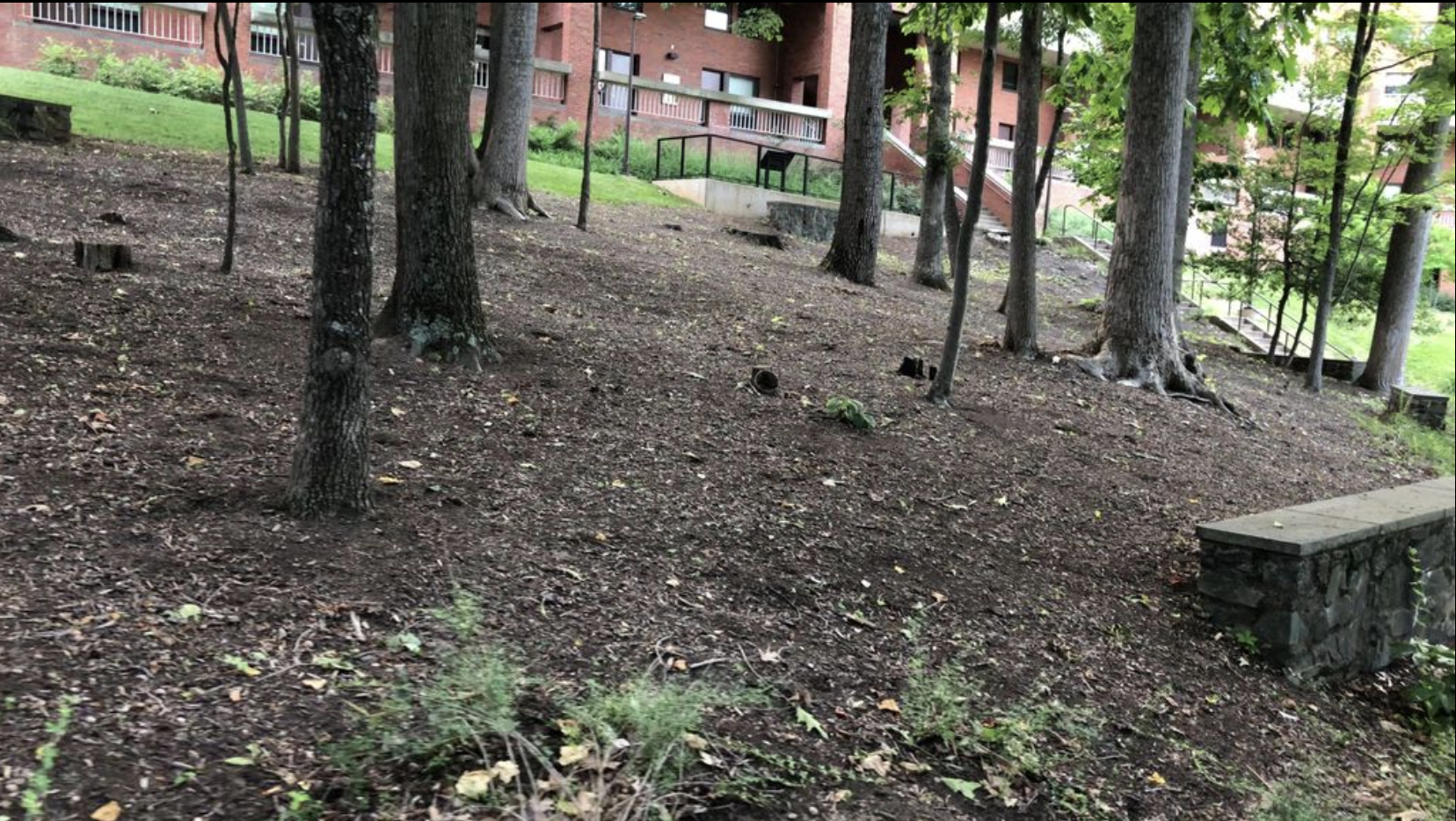
The Gooch-Dillard Enslaved Burial Ground is memorialized as one of the final resting places of individuals enslaved by Reuben Maury at the Piedmont plantation, now the site of the University of Virginia’s Piedmont Faculty Housing. The plantation was originally purchased and developed by Maury in 1809. The site where this burial ground sits, immediately adjacent to a Piedmont plantation property line, went through multiple ownership changes, including purchase by UVA for a brief period in the 1850s, and was last to UVA in 1947.
The only known connection between the cemetery and the Piedmont plantation comes from a Maury descendant who, during construction of the Gooch-Dillard dormitories in 1982, recalled that enslaved people had been buried in that area. Nine burial shafts were discovered after this information was shared. The exact number of graves is unknown, but archaeologists suggest that the site could have included dozens more burials.
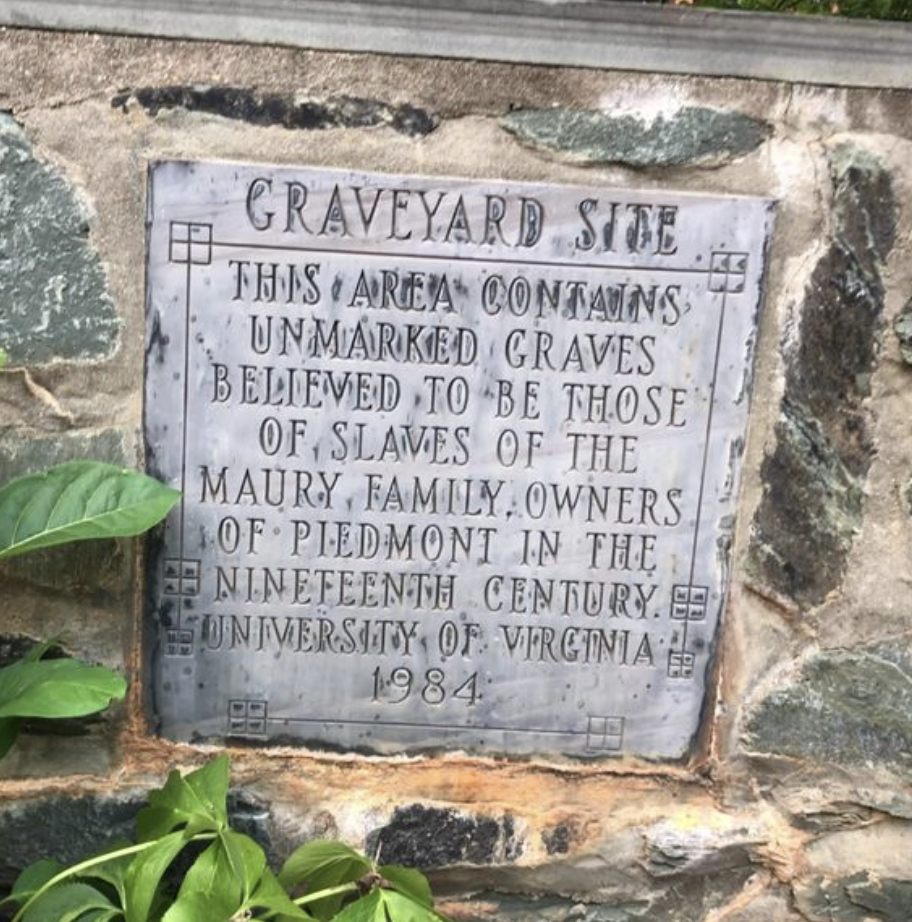
In 1984, the burial ground’s perimeter was demarcated with stone hip walls marking the extent of the cemetery. That same year, a commemorative stone plaque was added as part of a bench on a stairwell landing south of the site. The plaque remains today and reads: “Graveyard Site: This area contains unmarked graves believed to be those of slaves of the Maury family, owners of the Piedmont in the nineteenth century. University of Virginia. 1984.”
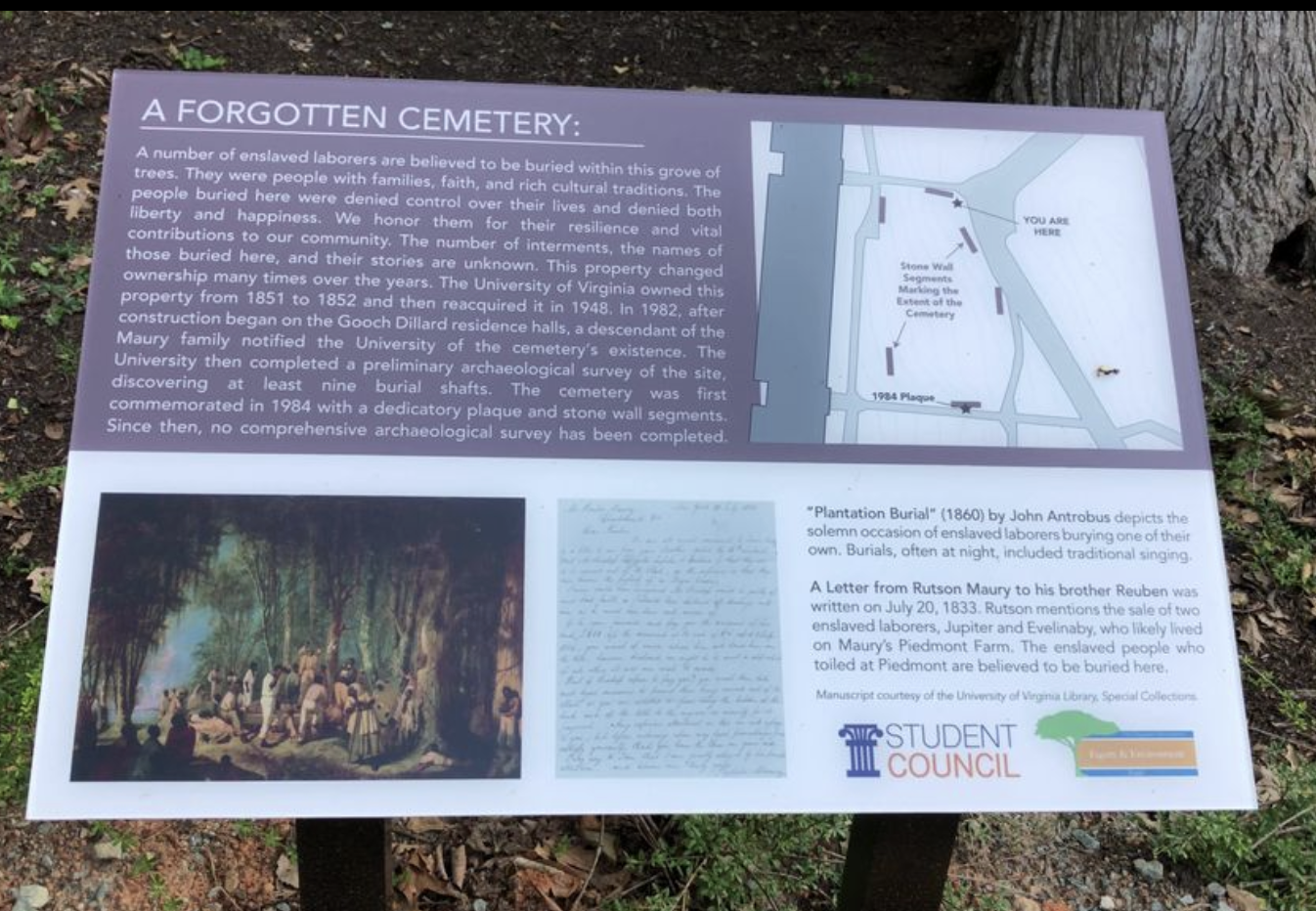
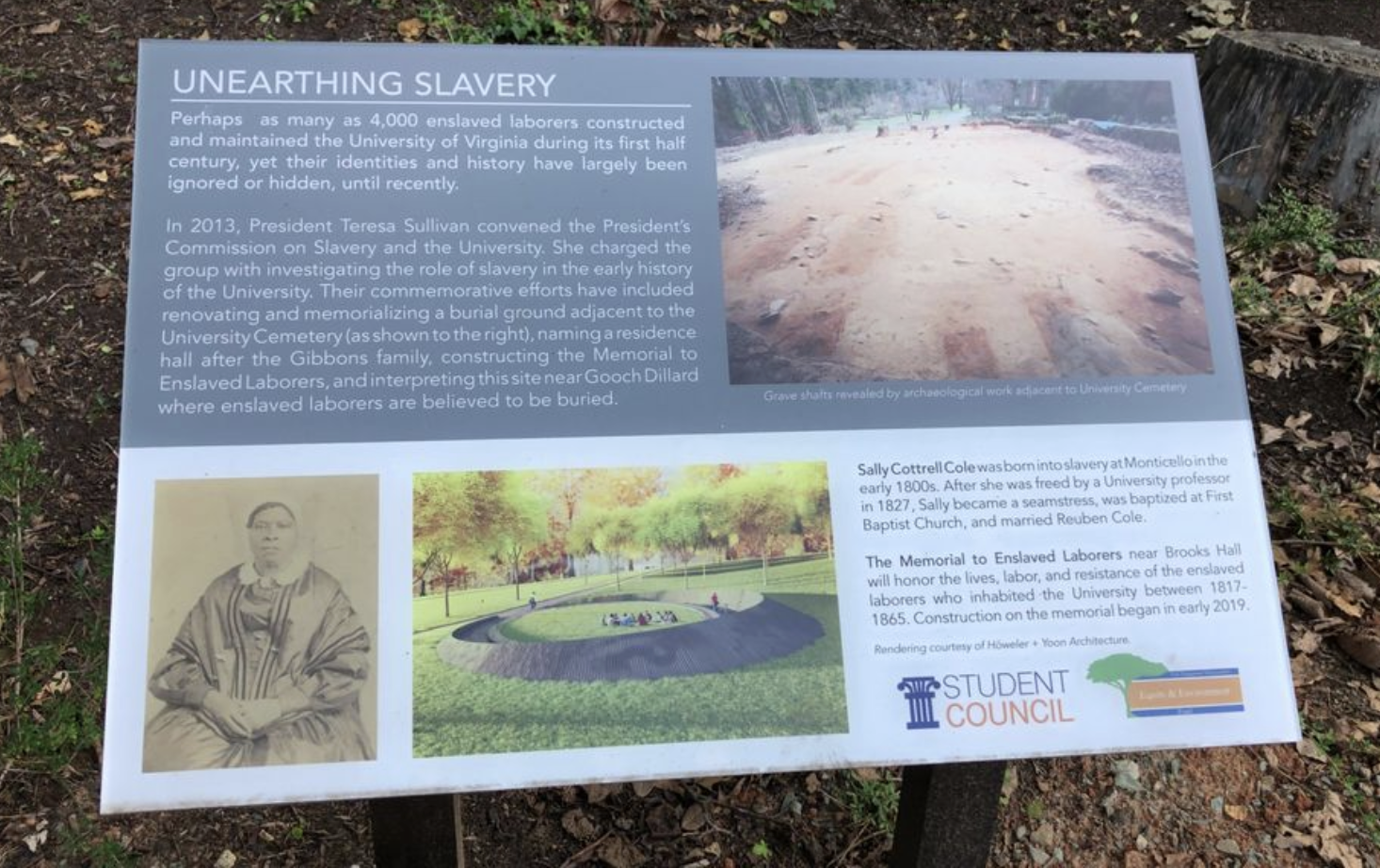
In 2018, UVA’s Student Council and the Equity & Environment Fund supported the addition of three interpretive panels adjacent to the site. These panels provide more context and honor the individuals buried there. The cemetery, located on a wooded slope near the Gooch-Dillard dormitory complex, remains a significant legacy of slavery today.
-
Four stone walls were constructed in 1984 to mark the perimeter of the burial site.
The commemorative plaque in 1984 was also made out of stone for its durability, and interpretive panels were added in 2018, which were likely made from metals or stone as well.
The gravesite itself lies on a slope in a wooded area, so it blends in with the surrounding area.
New interpretive panels, spearheaded by two student groups, UVA Student Council grant-funding, and UVA President's Commission on the University in the Age of Segregation (PCUAS) financial support were added at two locations adjacent to the cemetery in 2018-2019.
-
"GRAVEYARD SITE: This area contains unmarked graves believed to be those of slaves of the Maury family, owners of the Piedmont in the nineteenth century. University of Virginia. 1984."
-
"A FORGOTTEN CEMETERY: A number of enslaved laborers are believed to be buried within this grove of trees. The number of interments, the names of those buried here, and their stories are unknown.
This property changed ownership many times over the years. The University of Virginia owned this property from 1851 to 1852 and then reacquired it in 1948. In 1892, a descendant of the Maury family notified the University of the cemetery's existence. The University then completed a preliminary archaeological survey of the site, discovering at least nine burial shafts. The cemetery was first commemorated in 1984 with a dedicatory plaque and stone wall segements. Since then, no comprehensive archaeological survey has been completed.
“Plantation Burial” (1860) by John Antrobus depicts the solemn occasion of enslaved laborers burying one of their own. Burials, often at night, included traditional singing.
A Letter from Rutson Maury to his brother Reuben was written on July 20, 1833. Rutson mentions the sale of two enslaved laborers, Jupiter and Evelinaby, who likely lived on Maury’s Piedmont Farm. The enslaved people who toiled at Piedmont are believed to be buried here."
-
"UNEARTHING SLAVERY
Perhaps as many as 4,000 enslaved laborers constructed and maintained the University of Virginia during its first half century, yet their identities and history have largely been ignored or hidden, until recently. In 2013, President Teresa Sullivan convened the President’s Commission on Slavery and the University. She charged the group with investigating the role of slavery in the early history of the University. Their commemorative efforts have included renovating and memorializing a burial ground adjacent to the University Cemetery (as shown to the right), naming a resident hall after the Gibbons family, constructing the Memorial to Enslaved Laborers, and interpreting this site near Gooch Dillard where enslaved laborers are believed to be buried.
Sally Cottrell Cole was born into slavery at Monticello in the early 1800s. After she was freed by a University professor in 1827, Sally became a seamstress, was baptized at First Baptist Church, and married Reuben Cole.
The Memorial to Enslaved Laborers near Brooks Hall will honor the lives, labor, and resistance of the enslaved laborers who inhabited the University between 1817-1865. Construction on the memorial began in early 2019."
-
University of Virginia administration (1983-1984)
University of Virginia Equity & Environment Fund
University of Virginia Council (2018)
University of Virginia President's Commission on the University in the Age of Segregation (2019)
-
1984
-
2018
-
2019
-
University of Virginia's Equity & Environment Fund
UVA's President's Commission on the University in the Age of Segregation
UVA's President's Commission on Slavery and the University
Position: 1874 (50 views)