Items
-
Emancipated
A person known to have been emancipated from slavery by any means before, during, or after the Civil War -
Enslaved
A person enslaved before 1865 -
Emancipated
A memorial dedicated to someone known to have been emancipated from slavery by any means before, during, or after the Civil War. -
Enslaved
A memorial dedicated to someone known to have been enslaved. -
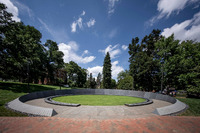
Memorial to Enslaved Laborers
For nearly five decades, the entire University was a site of enslavement. In 2013, President Teresa Sullivan formed the University of Virginia President's Commission on Slavery and the University (PCSU) to fully research the history of slavery at UVA, to educate the world, and to appropriately memorialize that history. In fall 2016, the design team of Howeler + Yoon was selected and hired as the University of Virginia slavery memorial design consultant. They worked with the PCSU to get community feedback about the proposed memorial (what might it look like? Where might it sit on Grounds? and so on…) from the wider community–students, faculty, staff, alumni, and neighbors in Charlottesville, Albemarle county, and Central Virginia. The resulting design beautifully captures the tenor of those community conversations, honors the lives, labor, and resistance of the 4-5,000 enslaved people who lived and worked at UVA at some point between 1817 and 1865. The memorial includes 4,000 memory marks in their honor. As J. Meejin Yoon of the design team says, “The memorial invites exploration. You can reach out and touch every mark.” The memorial was completed in spring 2020 and a public dedication was planned for April 2021, but the pandemic meant postponing the dedication for a year and moving it to a largely virtual ceremony in April 2021. Since the University of Virginia’s founding, the belief that inquiry and knowledge are essential to a thriving democracy has stood at its core. This focus has continually led UVA to seek new challenges, break through barriers, and pursue uncharted paths. Today, UVA leads the nation in deepening our understanding of the role of enslaved laborers in building our country and its institutions—including this University. The Memorial to Enslaved Laborers at the University of Virginia began with a student-led effort in 2010 and is a shining example of student self-governance. The memorial acknowledges and honors the 4,000 or more individuals who built and maintained the University. In addition to clearing land, digging foundations, fetching water, chopping and stacking wood, cleaning, and completing daily chores for students and professors, they engaged in highly skilled labor—including cooking, molding and firing brick, complex carpentry work, roofing, transporting and carving quarried stone, blacksmithing, working as scientific laboratory assistants, and making clothing, All these men, women, and children lived with dignity, resisted oppression, and aspired for freedom. -
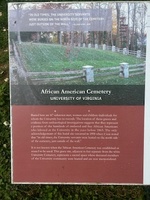
African American Cemetery at the University of Virginia
The cemetery was discovered in 2012 during an archaeological survey of the land just north of the University of Virginia Cemetery. That survey was conducted as part of a planned expansion of the university cemetery. Sixty-seven burials were identified and archaeological evidence indicates that approximately forty percent of the burials were of children. The only written documentation regarding the cemetery is from an alumni recollection written decades after the Civil War, although university records make scattered reference to deaths of the enslaved and include budget lines for inexpensive coffins (without indicating where they were to be buried). The grave shafts in 2012 all lacked formal headstones, but a few had what may have been intact fieldstones still in place. The site was renovated, landscaped, fenced, and interpreted with a permanent installation that opened in 2014. In fall 2014 and again in fall 2017, the University of Virginia President’s Commission on Slavery and the University (PCSU), in partnership with other UVA divisions and community organizations, held public memorial and libation services to acknowledge and consecrate the burial ground. -
Harry Flood Byrd, Jr., Professor of Government and Foreign Affairs
Endowed Professorships at the University of Virginia allow esteemed faculty members to receive honors for their work. One such professorship is the Harry Flood Byrd, Jr., Professor of Government and Foreign Affairs. The professorship, created in 1983 with donations from Albemarle County resident James F Lewis Jr's estate, is named after Harry F Byrd Jr, former senator of Virginia. His father, Harry F Byrd Sr, was also a senator in Virginia and played a critical role in the state during the Civil Rights Era with his championing of the 'Massive Resistance' to school desegregation movement. Byrd's father was one of the primary catalysts for the Massive Resistance movement and the overall attempt to thwart the democratization of education in America. Byrd Jr. himself followed in his father's footsteps by passing legislation upholding the ideals of Massive Resistance. Byrd Jr. was the architect of the Stanley Plan, which aimed to defy school desegregation and uphold segregation by closing off integrated schools and promoting segregated public education. In addition, Byrd Jr. attempted to restore the citizenship of Confederate General Robert E. Lee. Thus, Harry Flood Byrd Jr. attempted to uphold racial inequality in education as well as promote the mythology of the "Lost Cause." In 1970, in opposition to the Democratic Party's national stance in support of civil rights, Byrd Jr. left the party to run as an independent. Unsurprisingly, he was a part of his father's political machine, the Byrd Organization, a powerful political apparatus that controlled Virginia politics for much of the twentieth century. His continued political activity resisting integration and civil rights even after leaving the Democratic Party demonstrate that his legacy is both strongly linked to his father's leadership of the "Massive Resistance" effort, but also to his own opposition to school desegregation and the broader civil rights movement. -
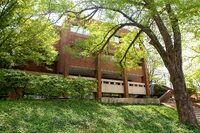
Ridley Hall
Ridley Hall, originally constructed in 1973, serves as the academic space for faculty, staff and graduate students of the UVA School of Education and Human Development (formerly the Curry School of Education). The hall was originally dedicated as Ruffner Hall after William H. Ruffner. It was built for the school of education, then named after named after Jabez Lamar Monroe Curry, a Confederate leader and post-Emancipation Virginia educator who was committed to a segregated two-track education system. In 2020, after researching both Curry and Ruffner and engaging with faculty, students, and alumni, the education school renamed, dropping Curry's name. They also renamed Ruffner Hall, choosing to memorialize Walter Nathaniel Ridley, who became UVA’s first Black graduate when he completed his doctorate in education in 1953. Ridley, born April 1, 1910, was one of eight children,.His grandfather had been born into slavery. Ridley earned his bachelor’s and master’s degrees at Howard University, and then applied for a doctorate at UVA, the only institution in Virginia that granted such a degree. While continuing to seek admission to UVA despite repeated denials, he taught psychology at Virginia State College (now Virginia State University), where he fatefully met Dean Stiles from UVA's Curry School of Education. After meeting with Stiles, Ridley applied again, this time twas admitted. He was also the first Black American to receive an academic doctoral degree from a traditional Southern white college or university. -
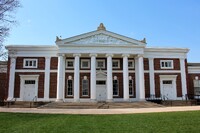
Cabell Hall
Cabell Hall, completed in 1898 and located at the southern end of the Lawn at the University of Virginia, is named after Joseph Carrington Cabell, a Virginia legislator and close ally of Thomas Jefferson. Cabell played a key role in the university’s founding by helping to secure state funding and shaping its early governance through his long tenure on the Board of Visitors, which he joined in 1815 and remained on until shortly before his death in 1856. Cabell was also a slaveholder. He is recorded as enslaving at least 108 people across his properties in Nelson County alone. These enslaved individuals labored at estates such as Edgewood, one of his principal plantations, and Corotoman, a property in which he owned a share. Cabell treated enslaved people as financial assets, shifting and selling them to increase profit without regard for family separations. He insisted on having enslaved workers whipped or beaten and dismissed concerns from his estate manager about the disruptive effects of his practices. Enslaved individuals frequently attempted to escape from Corotoman, reflecting the harsh conditions under Cabell’s oversight. His views on race aligned with dominant proslavery ideology, including support for black colonization and the belief that African Americans were incompatible of freedom and civilization in a republic led by white men. His important legacy as a founder of the University of Virginia cannot be understood without acknowledging the system of race-based slavery that sustained his wealth, power, and position in Virginia society. -
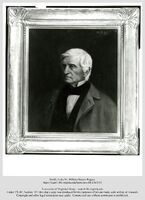
William Barton Rogers Endowed Professorship in Physics
William Barton Rogers taught natural philosophy and chemistry at UVA from 1835 to 1853. By 1840, Rogers had purchased at least two enslaved individuals, and census records indicate that he enslaved at least six people by 1850. The labor of these individuals supported his household at UVA and freed his time for academic work, publications, and teaching. After leaving UVA, Rogers went on to found the Massachusetts Institute of Technology (MIT), where he is widely remembered for his contributions to science and higher education. However, his legacy at UVA remains closely tied to the history of slavery through the William Barton Rogers Endowed Professorship in Physics. According to UVA’s list of endowed professorships, the chair was created to honor Rogers’ scientific achievements and long-standing connection to the university. The endowed professorship was approved by the Board of Visitors April 9, 1965. Naming a professorship after Rogers, although honoring his scholarship and academic leadership in the physical sciences, nonetheless represents a legacy of slavery, as he participated in human bondage while living in the South. Evenin the 1850s, while serving as President of the Massachusetts Institute of Technology, he publicly advocated for leaving slavery untouched where it then existed. -
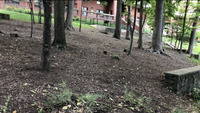
The Gooch-Dillard Enslaved Burial Ground
The Gooch-Dillard Enslaved Burial Ground is memorialized as one of the final resting places of individuals enslaved by Reuben Maury at the Piedmont plantation, now the site of the University of Virginia’s Piedmont Faculty Housing. The plantation was originally purchased and developed by Maury in 1809. The site where this burial ground sits, immediately adjacent to a Piedmont plantation property line, went through multiple ownership changes, including purchase by UVA for a brief period in the 1850s, and was last to UVA in 1947. The only known connection between the cemetery and the Piedmont plantation comes from a Maury descendant who, during construction of the Gooch-Dillard dormitories in 1982, recalled that enslaved people had been buried in that area. Nine burial shafts were discovered after this information was shared. The exact number of graves is unknown, but archaeologists suggest that the site could have included dozens more burials. In 1984, the burial ground’s perimeter was demarcated with stone hip walls marking the extent of the cemetery. That same year, a commemorative stone plaque was added as part of a bench on a stairwell landing south of the site. The plaque remains today and reads: “Graveyard Site: This area contains unmarked graves believed to be those of slaves of the Maury family, owners of the Piedmont in the nineteenth century. University of Virginia. 1984.” In 2018, UVA’s Student Council and the Equity & Environment Fund supported the addition of three interpretive panels adjacent to the site. These panels provide more context and honor the individuals buried there. The cemetery, located on a wooded slope near the Gooch-Dillard dormitory complex, remains a significant legacy of slavery today. -
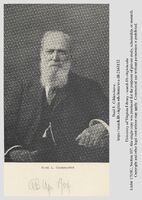
The Gildersleeve Endowed Professorship; A distinguished professorship for Classics professors commemorating Basil L. Gildersleeve
The Gildersleeve Endowed Professorship, established in 1991, is a prestigious position within the University of Virginia’s Classics Department, recognizing Basil L. Gildersleeve’s contributions to the field of classics and supporting distinguished scholars and professors in the field. Gildersleeve was a pioneering figure in American classical studies, making significant contributions to Greek and Latin scholarship. He was appointed as the chair of the Greek department at UVA before the age of 25 and later became a founding faculty member at Johns Hopkins University. The Gildersleeve Endowed Professorship is currently held by Anthony Corbeill. While Gildersleeve was a celebrated professor and scholar, he was also an unapologetic Confederate and outspoken advocate for slavery and white supremacy. In 1863-1864, he wrote over sixty editorials for Richmond newspapers, all defending the Confederacy and slavery. In “Miscegenation,” he warned against racial mixing, claiming the white race in North America was the purest and should stay that way. In “Sambo and the Ass,” he mocked Black Americans and dismissed their push for rights. After the Civil War, Gildersleeve promoted the Lost Cause. His book The Creed of the Old South (1915) romanticized the pre-Civil War South and defended the Confederacy as a noble cause. Naming a building and an academic professorship after Gildersleeve perpetuates UVA’s historical connection to white supremacy and slavery. The legacy of figures like Gildersleeve serves as a reminder of how the university once honored those who upheld the values of the Confederacy, and how this legacy continues to influence its identity today. -
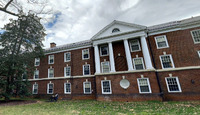
Gildersleeve Portal; Dormitory building dedicated to Basil Lanneau Gildersleeve
Gildersleeve Portal is one of the dormitories in UVA’s Brown Residential College. The building is named after Basil Lanneau Gildersleeve, a distinguished classical scholar and UVA graduate. Gildersleeve was a pioneering figure in American classical studies, making significant contributions to Greek and Latin scholarship. While Gildersleeve was a celebrated professor and scholar, he was also an unapologetic Confederate and outspoken advocate for slavery and white supremacy. In 1863-1864, he wrote over sixty editorials for Richmond newspapers, all defending the Confederacy and slavery. In “Miscegenation (missa-janay-shun),” he railed against interracial sex and families, claiming the white race in North America was superior and pure, and should stay that way. In “Sambo and the Ass,” he mocked Black Americans and dismissed their calls for citizenship rights. After the Civil War, Gildersleeve promoted the Lost Cause. His book The Creed of the Old South (1915) romanticized the pre-Civil War South and defended the Confederacy as a noble cause. Naming a building after Gildersleeve perpetuates UVA’s historical connection to white supremacy and slavery. The legacy of figures like Gildersleeve serves as a reminder of how the university once honored those who upheld the values of the Confederacy, and how this legacy continues to influence its identity today. -
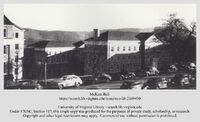
McKim Hall; Academic Building Dedicated to Randolph Harrison McKim
The University of Virginia's McKim Hall was built in 1931 as a nursing school dormitory and memorial to Randolph Harrison McKim (1842-1920). McKim Hall now houses administrative offices for the University of Virginia Health System. The funding for the building came from an endowment of nearly $70,000 left by Randolph H. McKim. McKim was a Confederate soldier, Episcopal priest, and Lost Cause supporter. As a student at UVA in 1861, McKim was inspired by the secession flag that students briefly hoisted on the dome of the Rotunda and joined the Confederate Army after graduating. He served as a lieutenant in the 4th Virginia Heavy Artillery and later as chaplain of the 2nd Virginia Cavalry. As a writer, McKim was a major Lost Cause activist. He documented his Civil War Confederate service A Soldier's Recollections, delivered a sermon eulogizing Robert E. Lee after his death, and authored numerous works in the early 20th century defending the Southern cause, including The Numerical Strength of the Confederate Army and Motives and Aims of the Soldiers of the South in the Civil War. McKim also claimed slavery was not a main concern for the South, blaming the English for introducing it to Virginia, in his work Contributions of the Anglo-Saxon Church in the Making of the Republic. McKim remained an avid participant in Confederate commemorative events throughout his life, including mounting ablets on the Rotunda in 1906 honoring students who had enlisted in the Confederate army and writing the inscription for the Confederate Memorial in Arlington National Cemetery. -
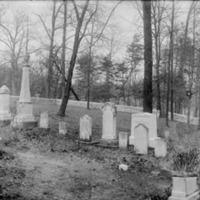
UVA Cemetery; a historically white cemetery
The University of Virginia Cemetery, located at the intersection of McCormick and Alderman Roads 1/3 of a mile west of the Academical Village, has served as the final resting place for members of the University of Virginia community since 1828. Initially created during a typhoid outbreak, it became the burial site for faculty, administrators, and their families. In 1966, its eligibility requirements changed to include alumni. The cemetery from 1991 to 2003 added two columbarium walls along the north border. In 2016, it expanded to the south, adding new burial plots and nine new columbarium walls. This walled cemetery space reflects UVA’s institutional history, containing the graves of notable professors, administrators, and their families. Generations of prominent professors were buried there. Among those interred prior to the 1970s are eugenicists, segregationists, pro-slavery ideologues, slaveowners, Confederate soldiers and officers, and promoters of Lost Cause mythology. Confederate service is noted on a number of tombstones. Today, the cemetery remains in use and is open faculty, administrators, members of the Board of Visitors, alumni, and long-employed staff. -
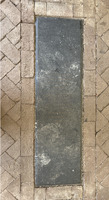
University of Virginia Plaque Honoring Enslaved Laborers (2007)
In 2007, as the state of Virginia prepared to launch a year-long celebration of 400 years of Virginia history, the General Assembly issued a statement of "profound regret" for slavery. The University of Virginia Board of Visitors issued a similar statement weeks later. The Board at that time rededicated itself and the University to the “principles of equal opportunity and to the principle that human freedom and learning are and must be inextricably linked in this commonwealth and in this republic.” Later that same year, the university installed the plaque to honor that Board resolution. The plaque is approximately fifteen inches wide and several feet long. It is located in the Southwest Corner of the Rotunda's cryptoporticus, the covered but open air walkway running East-West under the Rotunda's south steps, where it serves as an archway threshold. The plaque is very important at UVA, more for what has transpired after it was installed than for the plaque itself. In the two years after the plaque was installed, students organized, claiming the plaque represented inadequate recognition of the University’s complex history with slavery. Students felt that the plaque only recognized enslaved people secondarily and were likewise disappointed by its size and location. Student Council’s Diversity Initiatives Committee sought feedback about possible feelings on a revised memorial. Receiving sufficient interest in the project, the Committee formed the group Memorial for Enslaved Laborers (MEL) in 2009. In 2010-11, MEL held a competition for designs of an imagined memorial . The goal was to encourage the UVA community to consider calling for much more significant memorialization than the 2007 plaque. MEL chose three winners, hoping that the competition would increase community knowledge about the university's history and that the students’ designs might inspire future institutional memorialization. Around the same time, a group of alumni similarly began advocating for diversifying portraiture, honorifics, memorials, and plaques on Grounds. They endowed and formed the IDEA (Inclusion, Diversity, Equity, and Access) Fund in 2012 and began grant-funding new projects that fit with their mission. In 2013, those efforts spurred President Teresa Sullivan to create the UVA President's Commission on Slavery and the University (PCSU), the first institutional project fully researching slavery at the university and advocating for newly visible interpretation and memorialization (that effort resulted in the 2021 dedication of a large memorial to the enslaved). The 2007 plaque that started it all, however, is not easily spotted. as it is in the ground in an underground walkway, with small text running perpendicular to the direction of the walkway. The statement only acknowledges enslaved people as contributors to the University's construction from 1817 to 1826 and commingles them with much smaller number of free wage contractors and artisans involved in construction. As a result of several years of ferment stemming from objections to that 2007 plaque that culminated in the very public work of the PCSU, the Board of Visitors approved construction of a new memorial. The university selected design firm Höweler and Yoon to continue community engagement regarding the memorial’s design. In 2017, the Board approved the resulting design. This plaque, though in some ways a failure as a significant acknowledgement of nearly a half century human bondage at UVA, nonetheless started a decade of acknowledgement and atonement. -
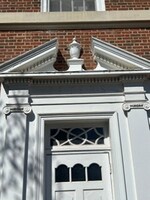
Peters Portal; A Dormitory Named for William Elisha Peters
William Elisha Peters was born August 28, 1829, in Bedford County, Virginia. He graduated from Emory and Henry College in 1850. Peters then pursued graduate study at the University of Virginia for two years before taking a professorship in Greek and Latin at Emory and Henry College. Peters stayed there until Virginia’s secession in 1861, when he enlisted in the Confederate military. Peters quickly rose through the ranks, by 1863 commanding the 21st Virginia Cavalry at rank of Colonel. He was wounded three times, twice seriously. He refused an order to burn down Chambersburg, Pennsylvania, and was immediately arrested but quickly released by Robert E. Lee. In 1866, he returned to UVA as a professor of Latin. He published widely on classics and Latin Language. Peters died in 1906 from pneumonia. UVA opened twelve dormitories for first-year students slightly west of Monroe Hill in 1929. The dormitories, or “portals,” were named after nineteenth century professors, including Peters. “Portal” is the term used to identify each building, but they are brick dormitories with classical architectural design features. These dormitories were renovated in 1986, but no changes were made to the buildings' names. . -
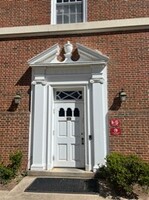
Mallet Portal; A Dormitory Named for John William Mallet
John William Mallet was born in Dublin, Ireland, in 1832. He grew up there and enrolled at Trinity College Dublin. He earned degrees from Trinity College Dublin and later Göttingen University. In 1853, he came to the United States on a research trip. While in America, took a job at Amherst College as professor of Analytical Chemistry. In 1854, he moved to the Deep South to become the Chair of Chemistry at the University of Alabama. With his marriage to the daughter of an Alabama judge in 1857, Mallet’s commitment to the slave South solidified. In 1861, Mallet enlisted in the Confederate military and was quickly promoted to first Lieutenant. He soon became Superintendent of Confederate ammunition factories at Macon, Georgia. He eventually rose to the rank of Lieutenant Colonel and headed all Confederate ordinance laboratories. At the war's end in 1865, he returned to academia, serving as professor of chemistry in the medical department of the University of Louisiana. He came to the University of Virginia in 1868, becoming professor of chemistry. He remained at UVA until 1883 when he became the University of Texas’ first professor of chemistry and chairman of the faculty. Only two years later, Mallet returned to UVA as professor of chemistry, where he remained until his retirement in 1908. In 1929, UVA opened twelve dormitories slightly west of Monroe Hill. The dormitories were named after nineteenth century professors, including Mallet. “Portal” is the term used to identify each building. They are brick dormitories with classical architectural design features. These dorms were renovated in 1986, but the buildings were not renamed. -
Altered - Restored
A memorial with this tag has been retouched and/or returned to a previous condition. -
Altered – Defunct
A memorial with this tag is no longer in effect. This tag applies only to lecture series, annual commemorative events, scholarships/prizes, and societies memorial types. -
Society of Jesus
Indicates a person who belonged to and served in any capacity with the Society of Jesus, a Roman Catholic order of priests and brothers.