Kitty's Cottage
Item
- Legacies Classification
- Memorial Type
- Memorial Context
- Memorialized Subject
- Title
- Background and Context
- Physical Description
- Memorial Inscription
- Creator/Participating Person(s)
- Date created, installed or dedicated
- Date Modified
- Historical Period
- Funded by
- Location: Institution, City, State
- Learn More About this Subject
-
Memorial Structure
-
Named Building
-
Boyd, Catherine
-
Kitty's Cottage
-
Catherine ("Kitty") Andrew Boyd was born enslaved in Georgia in 1842 and was bequeathed to Bishop James Andrew, the first chair of Emory's Board of Trustees, at age 12. At 19, Catherine was allowed to travel to Liberia, but she chose to remain in Georgia where laws prevented her from being freed. Andrew then built a small white cottage on his property where she could live independently. Despite this, he still legally owned her, which led to a lasting schism in the Methodist Church. Catherine eventually married Nathan Boyd, a free Black man, and they had three children. She died in 1851 at age 29.
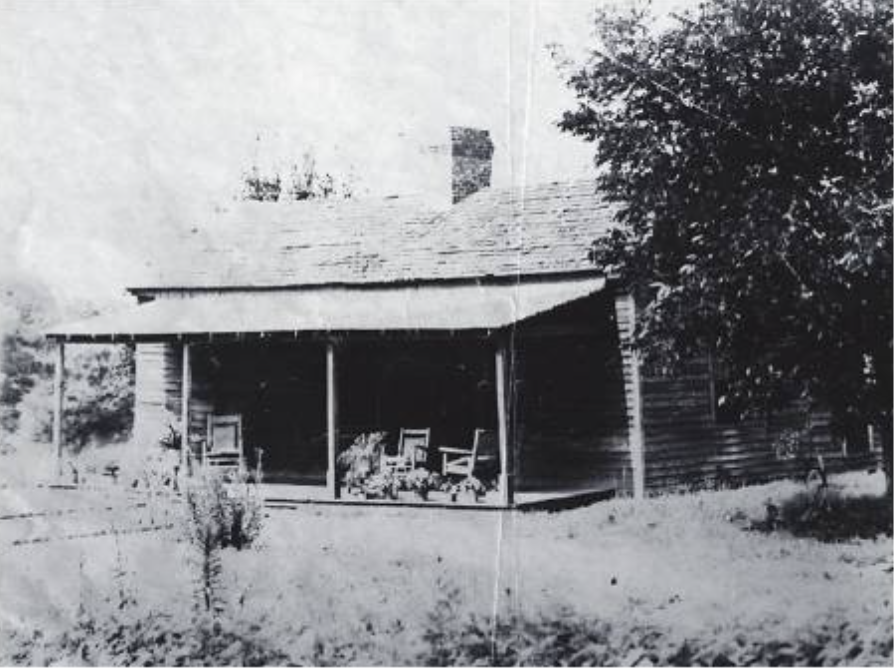
After 1916, the original Andrew house burned down, but Catherine's cottage remained. In 1938, H.Y. McCord, an Emory trustee, purchased the property to protect the cottage and relocated it to Salem Campground, a significant site for White Methodists in Georgia. The building was dedicated as a museum on July 4, 1939. Although the move preserved Emory's Southern heritage, local African-Americans criticized the decision, noting it was placed in a segregated area.
In 1993, Sam Ramsey advocated for the cottage’s return to its original location. It was moved back in 1994, but no Black residents were consulted. Restoration efforts began in 1995, with the Oxford Historical Society taking official ownership in 1997. Today, the cottage sits 30-60 feet from its original location, directly north of the Oxford campus of Emory University.
-
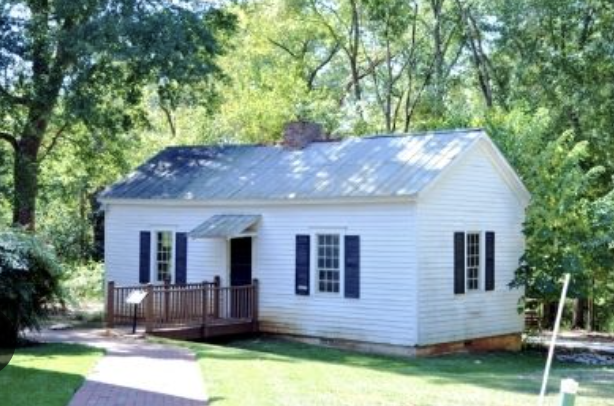
The building is a small, white, wooden cottage with a gray-brown, metal gable roof. An unfinished wood walkway with railings leads to the dark green front door, which is centered on the front-facing side. Above the front door is an awning. A red brick chimney extends from the center of the roof. The building sits on a wooden platform, which is the same color as the walkway. On either side of the front door are two small windows with white blinds and white borders. Each side of the building has one window. The exterior is painted white, and the windows are framed with white trim. A bronze commemorative plaque is located approximately two feet in front of the wooden walkway leading to the building. The structure is surrounded by grass, and the windows are rectangular with evenly spaced borders, providing a uniform appearance across the front and sides.
-
Kitty´s cottage was built in 1842 by Bishop James O. Andrew for an inherited slave who could not be freed and still live in Georgia; Kitty preferred to remain with the Andrew family rather than be sent to Africa. In 1938 Kitty´s cottage was bought and moved to Salem Campground for safe-keeping. In 1994 the board of Salem Campground offered to help move Kitty´s Cottage back to Oxford. The City and the Oxford Historical Shrine Society worked together to help bring this sacred treasure back home. It was placed behind Old Church, near its original site. It is now a museum.
-
Andrew, James
-
McCord, H.Y.
-
1842
-
July 4, 1939
-
1993
-
1994
-
Atkinson, Jack
-
Andrew, James
-
City of Oxford, Georgia
-
Georgia Department of Natural Resources
-
McCord, H.Y.
-
MGM Television
-
Oxford Historical Society
-
Ramsey, Sam
-
Salem Campground
Position: 1168 (76 views)