Men's Restroom: Composite of Early Faculty Who Made Sewanee "a child of the Confederacy"
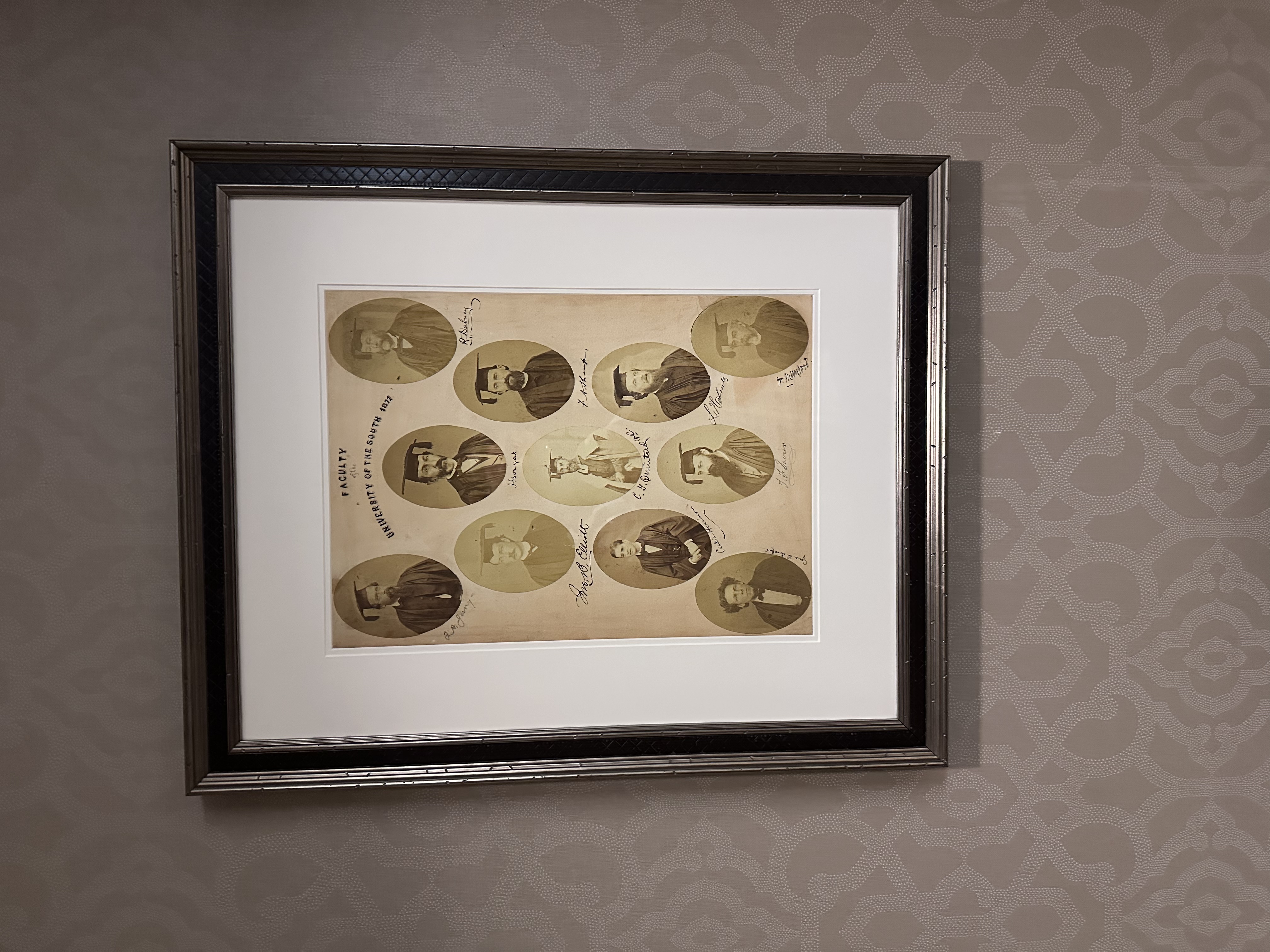
This framed composite of the 1871 faculty of the University of the South hangs on the wall just inside the entrance to the men’s restroom on the first floor of the Sewanee Inn. The only information about the men included along with the composite is that in the object itself. The object — with faculty members in their academic dress, including tasseled mortar boards — is a nostalgic relic of the University's earliest years.
Without additional information about the eleven figures, at least six of whom were Confederate veterans and defenders of slavery, if not enslavers themselves, the display of this relic also does the work of the Lost Cause. Its appearance without context separates the men depicted from the historical circumstances of their support for the Confederacy and the post-war prestige they held at the University of the South and in the region as a whole as veterans of the Confederate military.
What might a closer inspection of these men tell us about their connections to the Confederacy and slavery? Furthermore, what might more critical inquiry reveal about the links between the post-Civil War University of the South and its leaders’ and students’ romantic veneration of the Confederacy? “Long and illustrious is the list of the Confederate soldiers who rebuilt this institution” after the Civil War, Tennessee’s bishop and Sewanee’s chancellor, Thomas Frank Gailor, declared in 1929. "Gorgas, Sevier, Shoup, Kirby-Smith, DuBose, Hodgson — then Dabney and Harrison, and McCrady. Certainly, in a unique way and degree, the University at Sewanee is a child of the Confederacy and has a right to its name, ‘The University of the South.’”
At the center is the Rt. Rev. Charles Todd Quintard, the Episcopal Bishop of Tennessee and Vice-Chancellor of the University at the time, who had served in the Confederate military as a chaplain and was himself an enslaver.
In the four corners surrounding him, clockwise from the upper left corner, are F.A. Juny, instructor of modern languages; Robert Dabney, professor in various subjects, including metaphysics, English literature, political economy, and history; the Rev. William Mumford, instructor in the Grammar School; and John Locke Cooper, registrar. Little is known about Juny, Mumford, and Cooper, but Dabney, a graduate of Hampden Sydney College and the University of Virginia, served in the Confederate army.
In the circle surrounding Quintard, starting at the top, are Josiah Gorgas, professor of engineering; the Rev. Frances Asbury Shoup, professor of mathematics; the Rev. Lucian Holmes, assistant in the Grammar School; T.F. Sevier, assistant in the Grammar School; Caskie Harrison, professor of ancient languages; and John Barnwell Elliott, professor of chemistry. Of these six, Gorgas, Shoup, Sevier, and Elliott were veterans of the Confederate military. Gailor cited Caskie Harrison (born in 1848) as a Confederate veteran, but we have been unable to confirm that claim.
Use the following links to proceed to the Decorating with the Lost Cause introduction.