The Hearth Room: John Henry Hopkins Watercolors and a Tribute to Elliott's Legacy

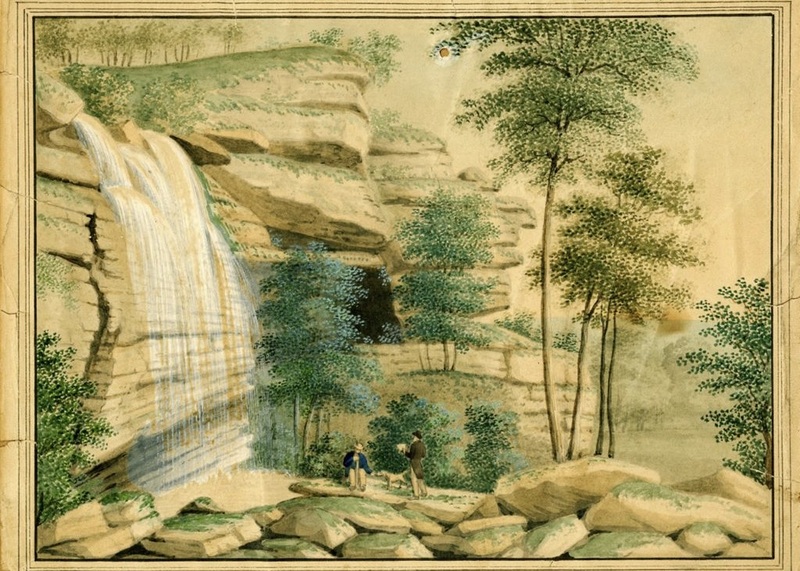
The Hearth Room, built into the heart of the Sewanee Inn, offers a view of the University of the South's manicured golf course. It is richly furnished and decorated with a series of watercolor landscapes by John Henry Hopkins, who served as the Bishop of Vermont between 1832 and 1865. Hopkins was a committed defender of slavery and friend to the founders of the University of the South, especially Bishops Leonidas Polk of Louisiana and Stephen Elliott of Georgia. Hopkins spent several months in the winter of 1859 on the University’s undeveloped and wooded “Domain” (campus), designing Sewanee's natural landscape to suit his Romantic vision for an exclusive Episcopal university. During that time, he produced these painted landscapes, which themselves represent, not an untamed wilderness, but a manicured, controlled woodlands encompassing the future campus of the University of the South. The watercolors (reproductions of the originals) hanging in the Hearth Room carry the aesthetics of the wide, grassy golf course outside into the Sewanee Inn. The natural world, in Hopkins’s paintings, is displayed according to the priorities of the University and its early supporters, who labored to compartmentalize, order, and control the landscape of the Cumberland Plateau. Hopkins himself, in The Bible View of Slavery (1861), contended that God had created a “grand system of order and gradation” in both nature and race, “from the eagle to the hummingbird,…from the lofty palm down to the humble moss,...from the mountains of granite down to the sand upon the shore,” and, among humans, from “the highly privileged Anglo-Saxon, which now stands at the head,…down the descending scale through the Turks, Chinese, Tartars, the Japanese, the Egyptians, the Hindoos, the Indian tribes, the Laplanders, the Abyssinians, the Africans.” Hopkins marveled at what he called “the vast diversity among the races of mankind”: “how is it possible to imagine that God has made them all equal!” Although Hopkins himself did not own enslaved people, The Bible View of Slavery insisted, against anti-slavery arguments to the contrary, that biblical scripture authorized the slavery in the United States of his day.
Use the following links to proceed to the Decorating with the Lost Cause introduction.