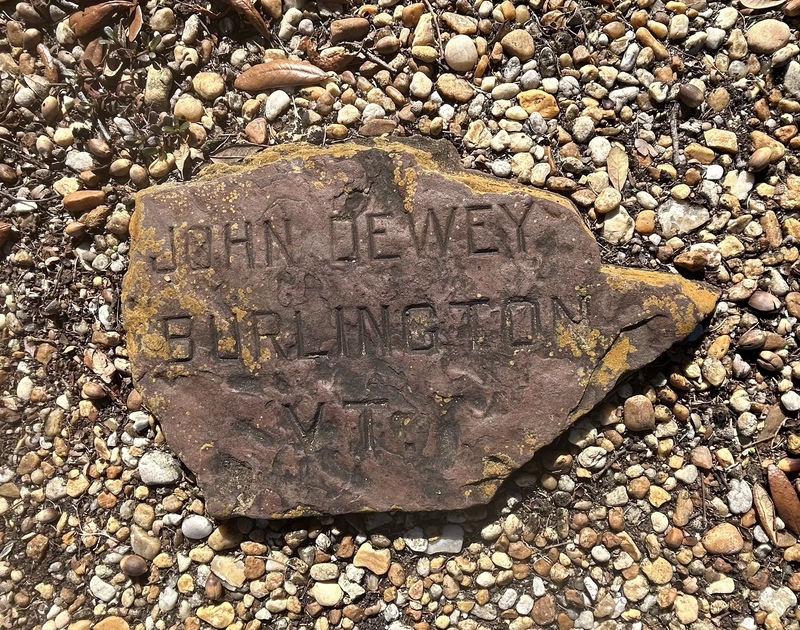
Stone memorializing John Dewey
Item
- Legacies Classification
- Memorial Type
- Memorial Context
- Memorialized Subject
- Title
- Background and Context
- Physical Description
- Memorial Inscription
- Creator/Participating Person(s)
- Date created, installed or dedicated
- Historical Period
- Funded by
- Campus Location
- Location: Institution, City, State
- Wikidata
- Learn More About this Subject
-
Memorial Object
-
Plaque/Marker
-
Dewey, John
-
Stone memorializing John Dewey
-
The “Walk of Fame” was created in 1929 by then-president Hamilton Holt to honor significant historical figures. The memorial is located in the center of campus around Mills Lawn.
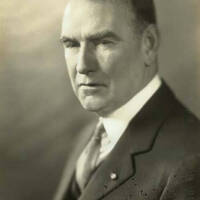
John Dewey (1859–1952) was a key figure in American pragmatism, known for his influential theories in education, psychology, and democracy. As a philosopher, he developed comprehensive views across various fields such as ethics, epistemology, logic, and aesthetics, often connecting his ideas to the broader history of philosophy. Dewey’s "cultural naturalism," rooted in a Darwinian worldview, critiqued traditional philosophy for being disconnected from real-world issues, advocating for a more practical and socially engaged philosophy. He rejected dualisms like mind/body and nature/culture, emphasizing that knowledge is an adaptive process rather than a purely rational pursuit of truth. Dewey believed that philosophy should address societal needs, integrating theory with practice. Beyond academia, he was an active public intellectual, contributing to discussions on human freedom, race relations, education, and more.
John Dewey’s views for African Americans began in the early 1900s, as he opposed the denial of their civil and political rights, lynching in the South, and inferior educational opportunities. He argued that there is no "inferior race" and believed all individuals deserve equal opportunities for social and personal development. His ideas continue to influence many fields, including education, political theory, and sociology. In 1931, John Dewey collaborated with Hamilton Holt on the Rollins Conference Plan, a forward-thinking initiative that reshaped the college's curriculum in alignment with his progressive educational theories and practices. Recognized for his groundbreaking contributions to education, Dewey championed experiential learning and the integration of democratic values.
-
The stone is irregularly shaped and measures approximately 36 x 23.2 cm. The surface is rugged and textured, with a reddish-brown coloration that appears weathered and stained. Yellowish lichen or moss growth is visible in patches across the stone.
-
JOHN DEWEY
BURLINGTON
VT
-
Holt, Hamilton
-
1931
-
Underwood & Underwood (New York, N.Y.)
Position: 2550 (31 views)